
For decades, enterprise software has followed a simple division of labor. Software stores, calculates, and displays information. Humans navigate the software, interpret what they find, and decide what to do.
The dashboard may be the purest expression of that model. I’ve spent much of my career working with and advancing dashboards at Cognos, IBM, and Board. Dashboards assemble information into a useful, consumable view, but the burden of turning that information into a decision still belonged almost entirely to the user.
What changed? Why? Which assumptions are now questionable? Who knows more? What alternatives do we have? What happens if we choose one?
Answering those questions requires people to move between dashboards, reports, planning models, spreadsheets, messages, meetings, and colleagues. The software provides the ingredients. But the human assembles the decision.
Agentic AI makes it possible to reverse that relationship.
The next generation of enterprise software will not simply wait for users to navigate to the right screen or formulate the right prompt. It will increasingly assemble context around a business problem, detect what changed, investigate likely causes, identify assumptions at risk, invoke governed models, generate scenarios, find relevant expertise, and determine which questions actually require human judgment.
The result is something different from both the traditional dashboard and the AI chatbot.
It is a decision environment.
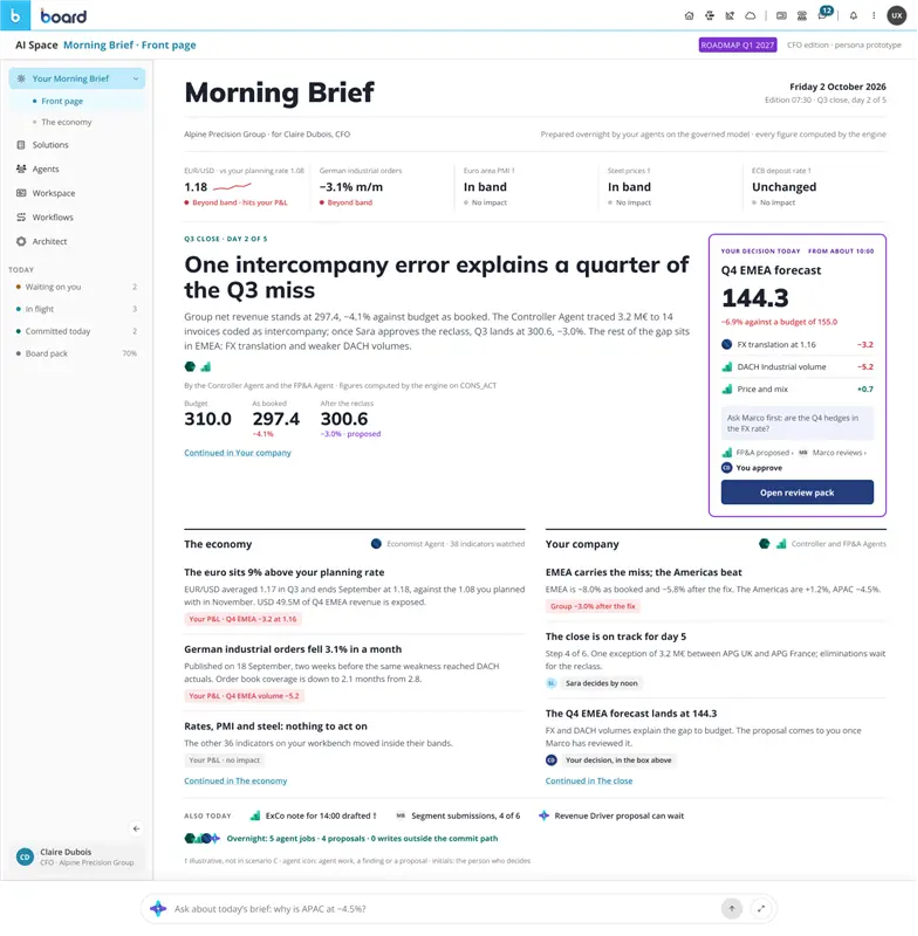
Board AI R&D Concept exploring a future experience where agents continuously monitor the business and assemble the decisions that require human attention.
The Decision Will Assemble the User Experience
Imagine a dynamic decision environment assembled around a decision rather than a static application organized around functions. Inside it, specialist agents investigate different dimensions of the problem, governed enterprise data and models provide a common factual foundation, scenarios expose possible courses of action, organizational policies define constraints, and human experts contribute context and judgment.
Now, imagine a sudden demand shift occurs. Instead of requiring a planner to move across a forecasting application, inventory reports, supply plans, financial models, and conversations with colleagues, the environment could assemble what is relevant to the decision itself: the changing demand signal, the most current forecast, available inventory levels, capacity constraints, margin implications, external indicators, and the assumptions behind the existing plan.
The workspace changes as the decision develops. An anomaly can trigger investigation. Investigation can expose an assumption. An agent can construct scenarios around that assumption. Those scenarios can surface a trade-off that requires an executive decision. Once the system makes that decision, it can preserve its rationale and coordinate the resulting actions. And once that decision is made, the environment can preserve its rationale, coordinate the resulting actions, and retain what happened as context for the next decision.
The critical point is that the system has not simply generated an answer or summarized a report.
It has assembled the decision environment.
That distinction matters because it suggests that the most important innovation in enterprise AI will not be putting a conversational interface on top of existing software. A simple chatbot beside a dashboard still leaves the dashboard, and ultimately the application, as the fundamental unit of interaction.
The more profound shift is to make the decision itself the fundamental unit of enterprise software.
Notably, the dashboard does not disappear. But it becomes only one ingredient the decision environment (or planner) can call upon when it is useful. The same may be true of a scenario model, variance table, workflow, narrative, or approval screen. Instead of forcing the user to navigate among these components, the software can increasingly assemble the right experience around the decision at hand.
That changes what software needs to understand. Not only data, but assumptions. Not only workflows, but decisions. Not only permissions, but authority. Not only models, but scenarios and their consequences. Not only what happened, but what requires attention now.
Planning systems are particularly interesting in this future because they already contain much of this machinery: assumptions, scenarios, business rules, constraints, calculations, workflows, and the relationships between financial and operational outcomes. Agentic AI creates the opportunity to bring those capabilities to the decision instead of asking the user to navigate between them.
It also clarifies humans’ role. More capable agents do not eliminate human involvement in consequential enterprise decisions. They change where human effort is most valuable.
AI can increasingly gather evidence, reconcile information, detect changes, trace causes, test assumptions, and construct alternatives. Humans remain responsible for judgment, weighing competing objectives, incorporating context that cannot be fully modeled, accepting trade-offs, exercising authority, and committing the organization to action.
That changes the design goal for enterprise software.
The interface of enterprise software therefore begins to shift from “Here is your information” toward “Here is the decision in front of you.”
Dashboards will not disappear overnight. Neither will reports, models, workflows, or applications. But they may cease to be the primary organizing principle.
Just as graphical user interfaces replaced command lines as the dominant way most people interacted with computers, agentic systems may eventually replace navigation as the dominant way people interact with enterprise software.
That future will require more than attaching agents to the applications we already have. It asks us to reconsider what the application itself should be organized around.
The defining question for the next generation of enterprise applications will no longer be: What does the user need to see?
It will be: What does the user need in order to decide?
BoardAI R&D Disclosure
A note on future-looking concepts: BoardAI.com is a forum for exploring the future of enterprise AI and planning. This article may include R&D concepts, prototypes, and perspectives on capabilities we believe could become possible over time. These concepts are illustrative and should not be interpreted as committed product capabilities, roadmap items, or release timelines. We will distinguish between capabilities available today and ideas we are actively researching or exploring.