
Enterprise AI already has a context problem.
We currently spend enormous energy improving what models can do. They can reason through complex problems, generate software, interpret documents, analyze data, and increasingly use tools to complete multi-step tasks.
But put one of those models inside a large enterprise and ask it to make a consequential business decision, and the problem changes quickly.
What does “revenue” mean here? Which forecast is authoritative? What assumptions are currently approved? Which customers matter strategically? What constraints cannot be violated? Is the company optimizing for growth, margin, or cash right now? Who has authority to approve the action?
The model does not inherently know.
This is why there is renewed attention around why semantic layers are important. Enterprises have already spent years teaching their systems what their businesses mean. Metrics, entities, hierarchies, and relationships have been debated, defined, and governed over time. AI should take advantage of that work rather than trying to reconstruct it from raw data.
While I fundamentally agree, I also think this is where the next AI problem begins.
Semantics can tell AI what the business means, but an autonomous system needs to understand what the business means in the context of the decision it is making.
That is a much higher bar.
Knowing What Revenue Means Is Not Enough
Consider something relatively ordinary: changing a forecast.
An agent may understand perfectly well how the company defines revenue. But before recommending a forecast change, it needs considerably more information than that.
Which version of the forecast is current? What assumptions did management approve? Which scenario are we evaluating? What capacity or policy constraints apply? Has the business already reviewed and rejected a particular course of action? And what approval workflow or decision right governs what happens next?
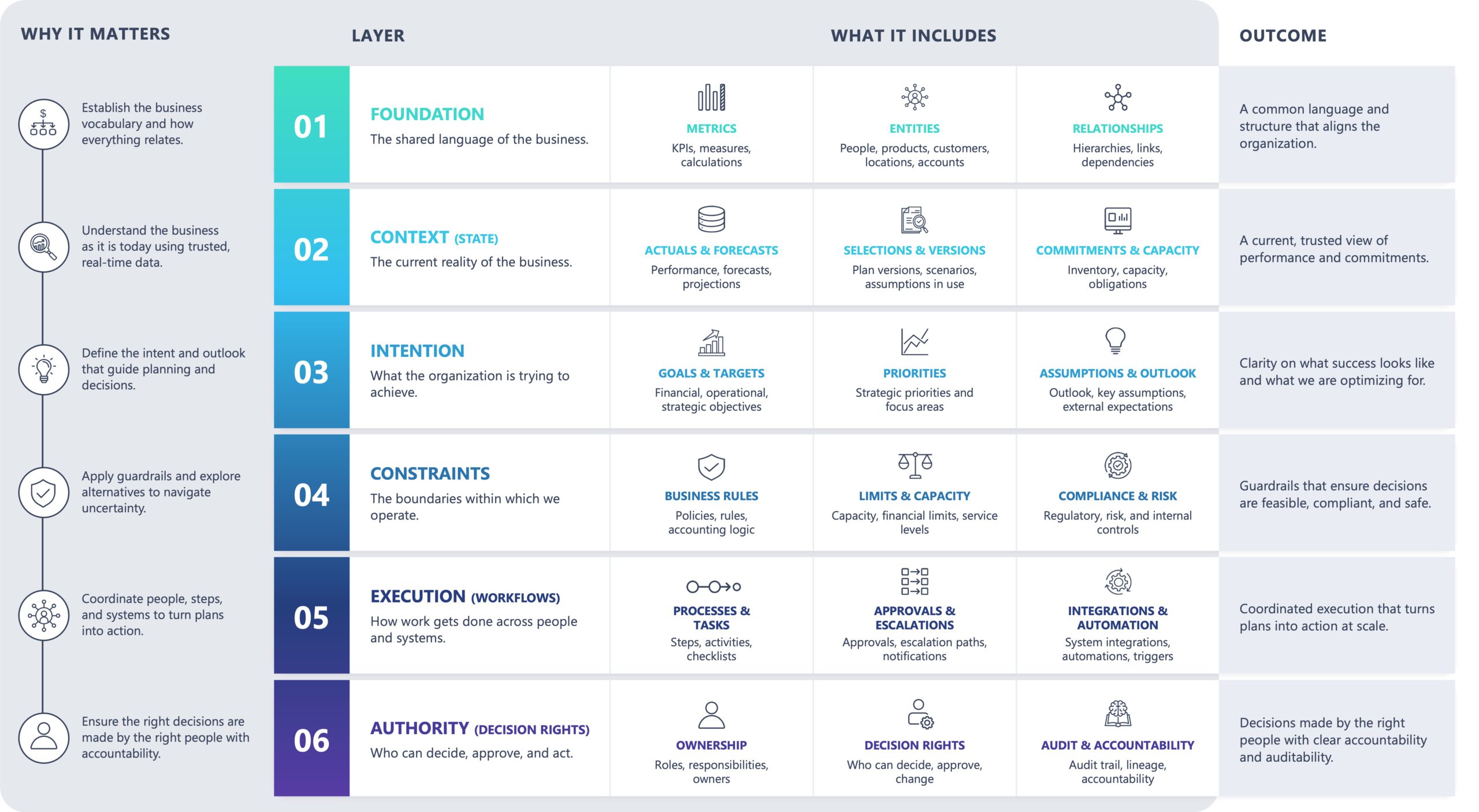
These are not simply semantic questions. They are part of the operating context around the decision: approved assumptions, active scenarios, planning constraints, workflow state, ownership, and prior decisions that have been formally captured.
Anyone who has worked inside a large enterprise should recognize this immediately. The numbers are only part of how a decision gets made.
This is why I believe the conversation will move from semantic models toward something richer: decision context.
The Business Has Already Spent Years Creating This Context
The interesting thing is that much of this context already exists. It just does not exist in one convenient place. Some lives in semantic models. Some is encoded in deterministic calculations, workflows, finance policies, and approval rules. And let’s be honest, an uncomfortable amount still lives in spreadsheets, meeting notes, and even in people’s heads.
That’s why enterprise planning systems are particularly interesting here. For decades, enterprises have used them to encode not only what their businesses are, but what they believe their businesses might become.
A planning model contains targets, assumptions, and scenarios that have not happened yet. It also represents constraints, drivers, and relationships between financial and operational outcomes. It knows which version of the future the company currently intends to pursue.
At Board, we have spent decades working with companies modeling this complexity. In the AI era, I have started to think about that accumulated planning context differently.
It is no longer just planning infrastructure. It is becoming intelligence infrastructure.
Context Has a Half-Life
There is another reason semantics alone will not be enough. Context changes.
The definition of gross margin may remain stable for years. The context in which someone makes a margin decision might change three times before lunch.
Perhaps a key supplier misses a shipment. Demand accelerates after a campaign. An unexpected tariff policy is announced. Management changes a target. Yesterday’s downside scenario often becomes today’s operating reality.
An intelligent enterprise therefore needs more than a well-defined representation of its business. It needs a representation that can move with the business.
Today we often assemble context when someone asks AI a question. Retrieve the relevant information, put it into the model’s context window, and generate an answer.
That is useful for AI assistants, but it will not be enough for autonomous systems continuously monitoring conditions and participating in decisions. They will need to understand what changed, whether it matters, what the organization is trying to accomplish, and which assumptions are no longer valid.
As you can see, in the world of the autonomous enterprise, context starts becoming less like a dictionary and more like a living state of the enterprise.
The Most Valuable AI Asset May Not Be the Model
At this point, it’s safe to say that foundation models will keep getting better. Agent frameworks and orchestration technologies will evolve. The model we consider state of the art today may look ordinary surprisingly quickly.
It’s also becoming clear that most enterprises will have access to many of the same models. So where will differentiation come from?
Your enterprise may not own the “smartest” model. But it definitely can own the richest understanding of how your business works.
That includes trusted metrics and hierarchies, but also what the organization learns through thousands of decisions.
Why did we override that forecast? Why do we accept a higher cost from this supplier? Why did management reject this scenario? Which assumptions repeatedly prove wrong? When does human judgment outperform the model?
Most organizations have accumulated enormous amounts of this institutional knowledge in their enterprise planning systems without treating it as an architectural asset.
AI is changing the economics of doing so.
Enterprise Memory Is More Than Chat History
This is why I think we need to be precise when we talk about AI “memory.”
Remembering that I asked a question yesterday is useful. But remembering why the company made a specific supply chain decision six months ago is far more valuable.
An automated AI memory system typically stores old conversation in a compressed format, using the langage model to tell apart important information from the less relevant ones. If the agent takes the wrong decision, suddenly the quality of the answers diminishes over time. An autonomous enterprise will need institutional memory that is governed and attributable. And not just what an agent recommended, but what assumptions it used, what a person approved action, what business KPIs were influenced, and whether that agentic decision should influence the next similar AI action.
The model gets better at understanding the enterprise because the enterprise continually gets better at representing itself for autonomous systems.
Eventually, the flow has to work in both directions. Imagine an agent identifies a risk, evaluates scenarios, and recommends an action. A planner modifies the recommendation before approving agentic action. Later, we know the result.
We now know what the AI recommended, where human judgment intervened, which assumptions held, and what outcome followed.
Why throw that knowledge away?
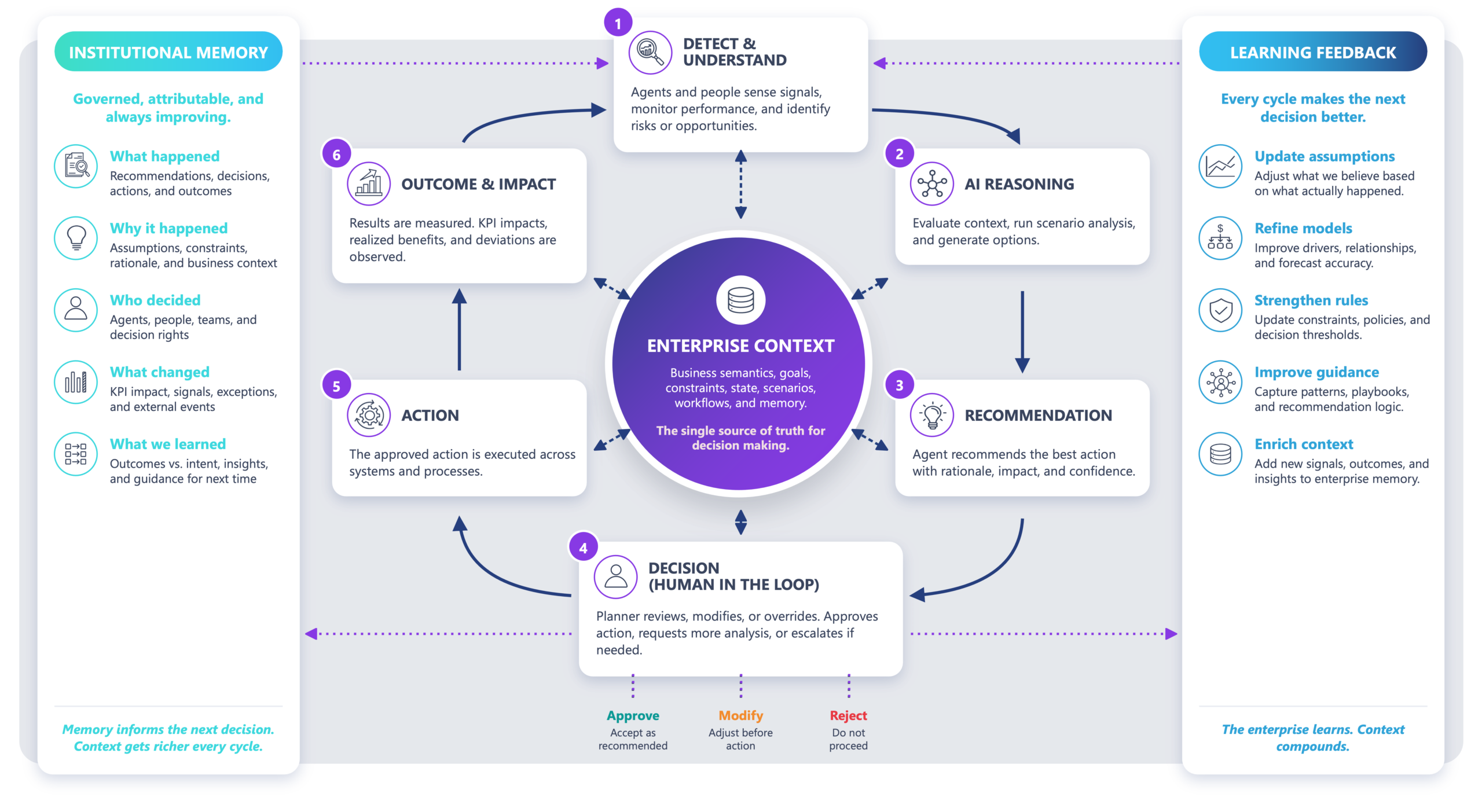
Over time, enterprise context should become richer because the organization is learning from its own interjections and decisions.
This is where the autonomous enterprise starts to become genuinely adaptive. Not because AI has been given permission to run the company, but because the organization becomes increasingly capable of sensing change, evaluating alternatives, acting, and learning.
That is closely connected to how we think about Continuous Planning at Board. Signals, scenarios, plans, actions, and outcomes should form a connected loop rather than disappear into separate systems and planning cycles.
Build the Architecture Around What Will Endure
For CTOs, the architectural implication is straightforward.
Do not couple the enterprise’s understanding of itself too tightly to whichever model or agent framework happens to be leading today.
Models will change. Interfaces will change. Agent architectures will change.
Your business context must endure these changes. It should not be static. It should evolve as the business changes and learns, but deliberately, with governance, lineage, and accountability.
In practice that means treating context as its own architectural tier, not as prompt engineering. Definitions, assumptions, constraints, scenarios, and decision rights live in a governed layer with versioning and lineage — and models, whichever ones you use this quarter, consume it through stable interfaces rather than having it hand-fed into context windows. A useful test: if you swapped your foundation model tomorrow, what would your AI forget about your business? If the answer is “almost everything,” your context is trapped in prompts and integrations. If the answer is “nothing,” you have an architecture.This is increasingly how we think about Board’s role in bringing our vision of the autonomous enterprise to the market.
Board remains an Agentic Planning Platform, but as agentic AI moves closer to autonomous decisions, the context contained within planning becomes strategically ever more important. Planning models contain semantics, but also assumptions, scenarios, constraints, deterministic calculations, workflows, and decision rights.
We describe this evolving role as the Contextual Decision Layer: a governed environment connecting enterprise AI to the business context through which consequential decisions are understood, evaluated, and ultimately put into action.
The autonomous enterprise will certainly need more powerful AI. But power without context is not intelligence you can safely operationalize.
Models will change. The real architectural advantage will be how deeply your AI understands the business those models are being asked to run.