
For the past several years, the conversation about AI in finance has centered largely on productivity.
Can AI accelerate variance analysis? Draft management commentary? Reconcile accounts? Improve forecasting? Free FP&A teams to spend less time gathering information and more time advising the business?
Those questions still matter. But they are quickly becoming the easy ones.
As AI moves from answering questions to recommending actions, and eventually initiating them, CFOs face a more consequential question: What should AI actually be allowed to decide?
Imagine an AI agent monitoring the business detects deteriorating demand in a major market. It concludes that the current revenue forecast is increasingly unlikely, identifies the drivers, evaluates external signals, and generates three scenarios for the remainder of the year.
Now the interesting part begins.
Should the AI agent alert the FP&A team? Explain the variance? Recommend a new forecast? Enter a proposed change? Route it for approval? Adjust spending assumptions? Trigger changes in inventory or production plans?
We might call all of this “AI-powered forecasting.” But each step represents a fundamentally different level of authority. For CFOs, that distinction is about to become critical.
Finance Needs Decision Governance, Not Just AI Governance
Finance has governed automation for decades. We inherently understand the segregation of duties, materiality thresholds, delegated authorities, reconciliations, approval workflows, and the necessity of audit trails.
The proliferation of agentic AI capabilities is introducing a new decision-making paradigm. Let me explain.
Traditional automation generally followed a predetermined instruction: when X happens, do Y.
But an intelligent agent can increasingly interpret a situation, consider alternatives, and conclude: given what is happening and the objective I have been given, I believe Y is what we should do next.
That moves AI much closer to the decision itself.
Our response cannot simply be to put a human somewhere in every workflow. Nor should it be to prevent AI from assuming greater responsibility. Instead, CFOs need to extend a discipline finance already understands well, delegated authority, to intelligent systems.
I think of this as “appropriate autonomy.”
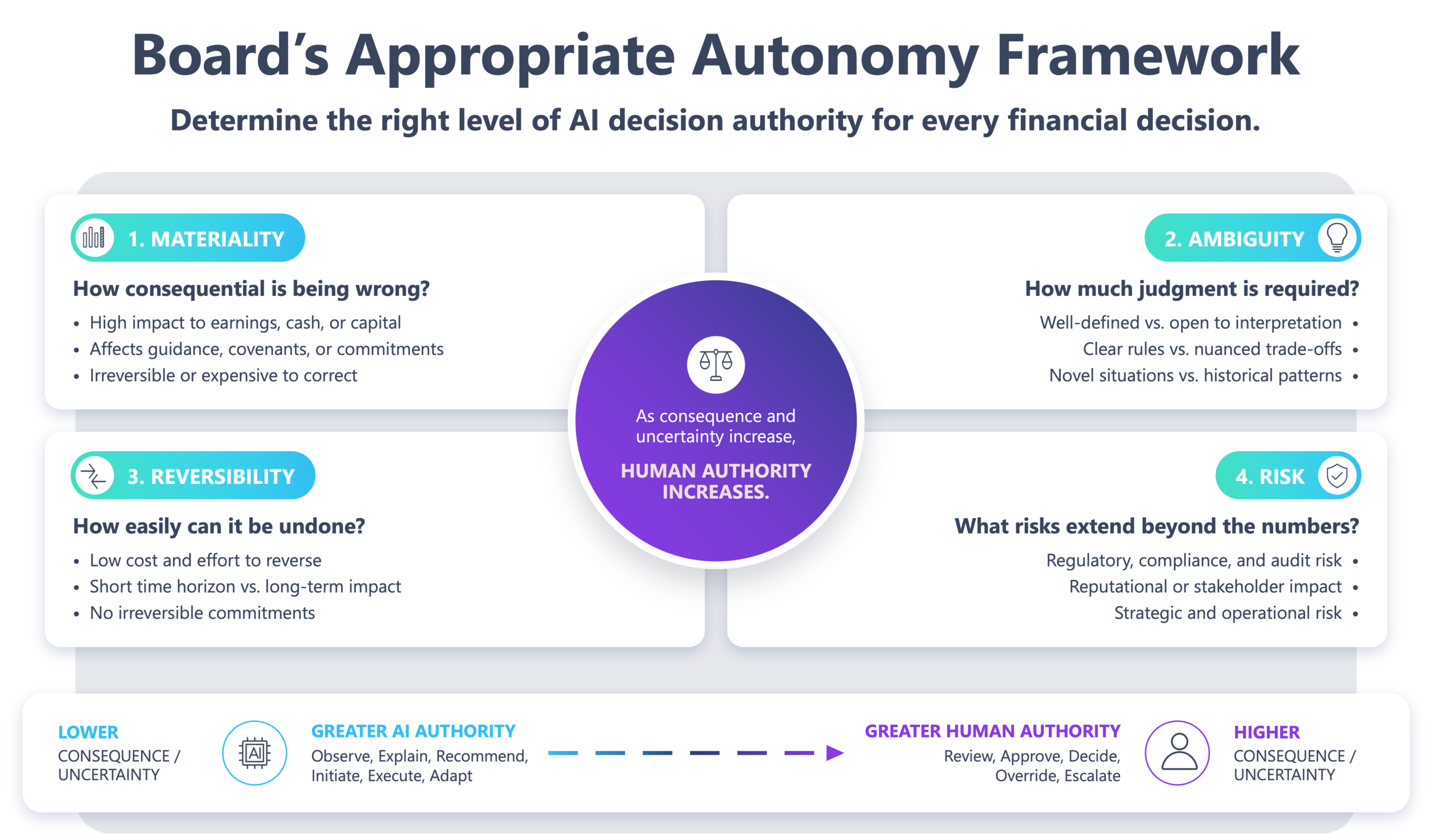
The objective is not to make finance as autonomous as technically possible. It is to determine the highest useful level of machine authority appropriate for each decision.
At Board, we’ve created four questions to help establish that boundary:
Materiality: How consequential is being wrong? Detecting a small variance and recommending a major capital reallocation deserve very different thresholds.
Ambiguity: How much judgment is required? Matching an exception against established rules is different from deciding whether a demand decline is temporary or structural.
Reversibility: How easily can the decision be undone? Running another scenario costs very little. Committing capital, changing customer terms or communicating guidance may not be easily reversible.
Risk: What are the consequences beyond the immediate financial outcome? Regulatory, fiduciary, reputational, strategic and control risks all matter.
As consequence and uncertainty increase, so should human authority. Where they are low, AI can be given considerably more room to operate.
Don’t Automate Finance. Decide What to Delegate.
This is why I believe asking whether finance should become “autonomous” is the wrong question. Finance is not just one process. It is thousands of decisions.
Consider FP&A. AI can increasingly monitor performance, identify anomalies, investigate drivers, test assumptions, and generate scenarios. It may recommend a forecast change.
But recommending a forecast and approving one are not the same decision.
The same distinction applies to the controller. An agent might identify an intercompany mismatch, gather the evidence, and recommend how it should be resolved. That does not mean it should automatically post the adjustment.
Or let’s consider working capital. An intelligent system could identify deteriorating Days Sales Outstanding (DSO), determine which entities or customers are driving it, and recommend interventions. I believe most of my CFO peers would agree that giving that same intelligent system the absolute authority to change customer payment terms is a very different proposition.
Key Point: The unit of AI governance should therefore increasingly become the decision, not the application.
CFOs should be able to look across the Office of Finance and ask not simply where AI is deployed, but how much authority it has for each class of decision.
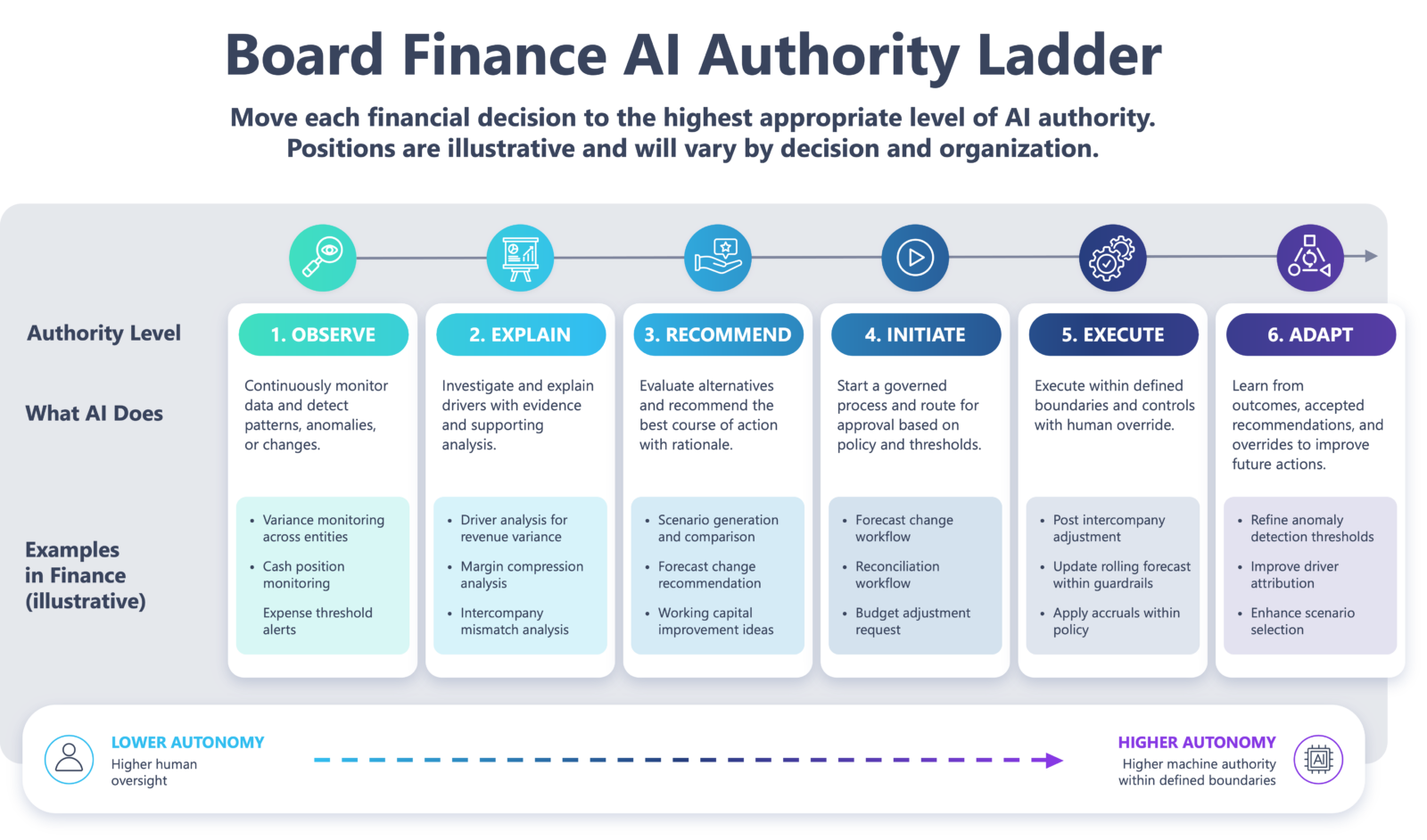
At one end, AI observes, continuously monitoring for something requiring attention. Then it explains, investigating drivers and assembling evidence. Next, it recommends evaluating alternatives and proposing an action.
With greater authority, it can initiate, starting a governed process that requires authorization before commitment.
For appropriate decisions, it may eventually execute within explicitly defined boundaries. Over time, systems may also adapt, using outcomes and human overrides to improve future recommendations.
We believe this is a more realistic path to autonomous finance. Organizations do not have to leap from copilots to machines making consequential decisions. They can move individual decisions along this spectrum as confidence, technology, and governance mature.
“Human in the Loop” Is Not Enough in the Long Run
There is a phrase we hear constantly in discussions about AI governance: keep a human in the loop.
I agree with the principle. But it is not going to be enough.
Imagine an AI system producing thousands of recommendations that finance professionals routinely approve because reviewing each one in depth is impractical. A human may technically be involved, but meaningful oversight has disappeared.
The real question is not whether a human is present. It is when human judgment is required and what that person needs to make the decision well.
What triggers escalation? What evidence accompanies the recommendation? Which assumptions changed? Where is the uncertainty? Who has authority to approve? What gets recorded so the decision can be understood later?
This will fundamentally change how finance works.
The future finance organization will not simply use AI. Increasingly, it will supervise systems of AI-assisted decisions.
That should be exciting for up-and-coming finance professionals, not threatening. AI can investigate thousands of deviations people would never have time to examine, continuously challenge assumptions, and surface risks that might otherwise emerge weeks later.
Finance will finally be able to spend less time finding the problem, and more time deciding what the organization should do about it.
Before AI Gets Authority, It Needs Context
But authority has a vital prerequisite. Before delegating a consequential decision to an AI system, CFOs should ask a deceptively simple question:
Does it actually understand the decision?
Access to data is not the same as understanding the business. This distinction will be an extremely consequential part of the partnership between finance and technical systems teams.
An AI system evaluating a forecast needs to know more than just revenue history. Which forecast version is authoritative? Which assumptions are approved? Which hierarchy applies? Which scenario is being evaluated? What thresholds are material? Which business rules govern the calculation? What operational constraints affect the available choices?
Experienced finance professionals absorb this context over years. AI cannot reliably infer all of it from a collection of tables.
That is why the foundation beneath enterprise AI will matter as much as the intelligence of the models themselves. AI needs governed business definitions, planning models, assumptions, hierarchies, permissions and workflows that give meaning to the numbers it analyzes.
My rule would be simple: Do not delegate a decision to an AI system until you can demonstrate that it has the context required to understand the ramifications of that decision.
If you’d like to learn more about our approach to improving contextual awareness for enterprise AI, my colleague, David Marmer, Board’s Chief Product Officer, recently announced the Board Contextual Decision Layer.
Let AI Reason. Let Governed Systems Calculate.
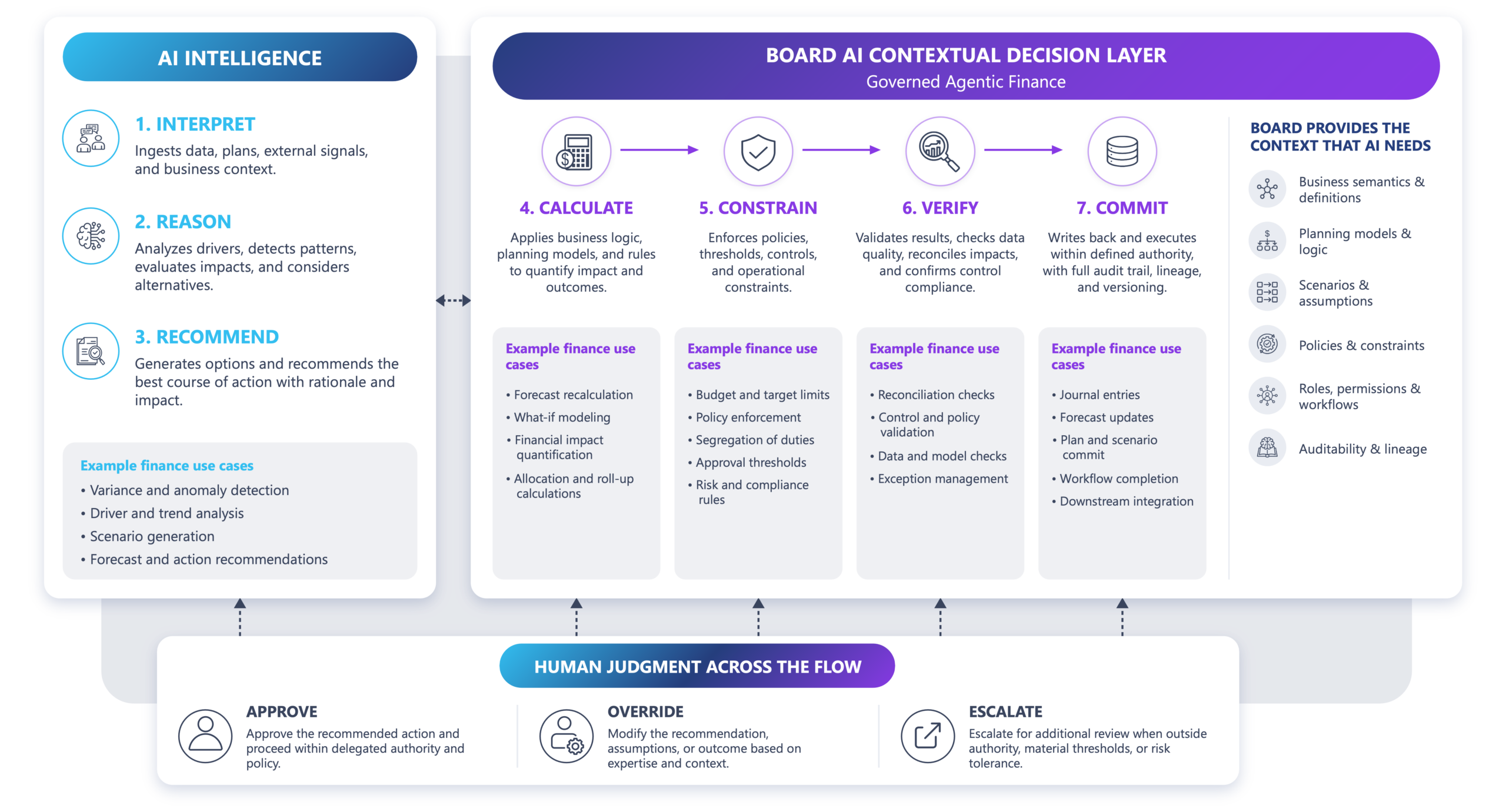
Related to this, and equally consequential to AI’s success for finance, is a distinction savvy CFOs must insist upon. AI is extraordinarily powerful at interpretation. It already can identify patterns, synthesize information, formulate hypotheses, and propose alternatives. But financial decisions often depend on things that should not change according to how a model happens to reason on a particular day.
Accounting logic. Allocations. Consolidation rules. Planning calculations. Security permissions. Approval thresholds. Operational constraints. Even in a future business climate with substantial AI autonomy, these will need to remain deterministic and highly governed. We will undoubtedly see enterprises that get this wrong in the coming years.
Probabilistic AI should interpret, reason, and propose. While deterministic engines and governed systems should calculate, constrain, verify, and commit.
This matters even more as finance becomes connected to operational decisions.
A change in demand can affect revenue, inventory, production, working capital, and cash. A recommendation that looks sensible within one function can create consequences somewhere else.
The CFO therefore needs more than an intelligent answer. Finance needs to understand the trade-offs, model the consequences, and maintain alignment between financial and operational plans as decisions change.
That is the point at which AI stops being merely a productivity tool and starts becoming part of the enterprise’s decision architecture.
Finance Can Lead the Enterprise Into the AI Era
It would be easy to frame all of this primarily as a new control problem. I see a much bigger opportunity. Finance may be one of the functions best equipped to help the enterprise get this right.
CFOs understand materiality. Controllers understand controls and auditability. FP&A understands assumptions, scenarios, and uncertainty. Finance knows that authority requires boundaries, and consequential decisions require evidence and accountability.
Those disciplines do not stand in the way of AI adoption.
They are what can allow us to go further with it.
The organizations that create the most value from AI will not necessarily be those that automate the most. They will be those that become exceptionally good at determining where machines can operate independently, where people and machines should decide together, and where human judgment must remain decisive.
And that boundary should move over time.
As AI improves, business context becomes richer, governance matures, and organizations accumulate evidence about which decisions machines handle well, CFOs should be willing to expand the authority they delegate.
But they should do so deliberately.
The future of finance is not a choice between human judgment and autonomous AI. It is a new division of labor between them.
One of the most important decisions the CFO will make is deciding where to draw that line.