
Recently, the easiest way to make the financial case for AI has been to count work. Hours saved. Tasks automated. Employees using copilots. Reports generated. Queries answered. Cost per interaction. Perhaps even headcount avoided.
Of course, these measures matter. They help CFOs understand adoption, productivity, and cost. But they will become less useful as the primary measure of AI’s economic value.
Why? Because AI is beginning to do something more consequential than helping people complete work faster.
It is beginning to influence decisions.
An AI system might identify a deteriorating cash position before an analyst does. It might challenge the assumptions behind a forecast, recommend a different inventory position, identify an emerging margin risk, or generate scenarios that change where the company deploys capital.
In those situations, the economic value of AI is not primarily the 20 minutes, two hours, or two days it saved. The real question becomes: Did AI help the organization make a better decision, and what was that decision worth?
I believe that question will become central to how CFOs evaluate AI in the next phase of adoption.
AI is Moving From an Adoption Problem to a Value Problem
Enterprise AI investment is not slowing while CFOs wait for a perfect ROI methodology.
Gartner reported earlier this year that AI deployment had grown from roughly two in five organizations in 2024 to four in five today. Within finance, nearly 60% of CFOs planned to increase AI investment by at least 10% in 2026.
Yet value realization is proving more complicated.
In a March 2026 survey of finance leaders, Gartner found that 66% of finance organizations using AI cited efficiency and productivity as a leading benefit. But 63% said implementation had been slower than expected, while forecasting and insight generation were among the AI use cases struggling to generate high impact. Gartner’s conclusion was direct: CFOs should stop mistaking deployment for value creation.
McKinsey sees a similar disconnect. Nearly eight in ten organizations in its research are using generative AI somewhere in the business, and 62% are experimenting with agentic AI, yet many organizations still cannot confidently answer whether those investments are creating bottom-line impact.
This is a natural stage in the evolution of a major technology.
The first question was, can we use AI? Then came, where can we deploy it?
Now boards and management teams are asking the question CFOs were always going to have to answer: Where is the return?
Today’s AI ROI Measures Are Necessary, but Not Sufficient
The good news is that thinking about AI ROI is becoming more sophisticated.
Gartner argues that CFOs should not force every AI investment through one ROI formula. Productivity use cases, targeted process improvements and transformational investments have different economics, timelines and risk profiles. Gartner also argues that value can appear first through better decisions and greater agility before becoming visible in traditional financial metrics.
Forrester similarly distinguishes between where AI’s value appears, such as revenue, efficiency or risk reduction, and how that value is created through mechanisms such as productivity, engagement, or strategy.
And finally, McKinsey proposes tracing AI through multiple layers, from technical performance and adoption through workflow and strategic outcomes to enterprise financial impact. Its central point is important: companies need accountability for value from the beginning rather than trying to reconstruct the business case after deployment.
All of this represents progress.
But I think CFOs will need to take the argument one step further.
As AI becomes more agentic, the important unit of measurement will increasingly become the decision.
A New Discipline: Decision Economics
Let’s consider an AI agent that detects deteriorating Days Sales Outstanding (DSO) and identifies the customers responsible. If the analysis that previously took four hours now takes four minutes, we have measurable productivity value.
Suppose it also automatically prioritizes the accounts requiring attention and reduces a two-day working-capital review to two hours. Now we have improved the economics of the workflow.
But suppose the earlier warning causes finance to change its collections strategy before quarter end, resulting in several million dollars of cash arriving earlier than it otherwise would have.
That is something different. The value of the AI is no longer adequately described by hours saved.
The AI changed a decision, the decision changed an action, and the action changed an economic outcome.
I believe CFOs need a better way to distinguish these forms of AI value.
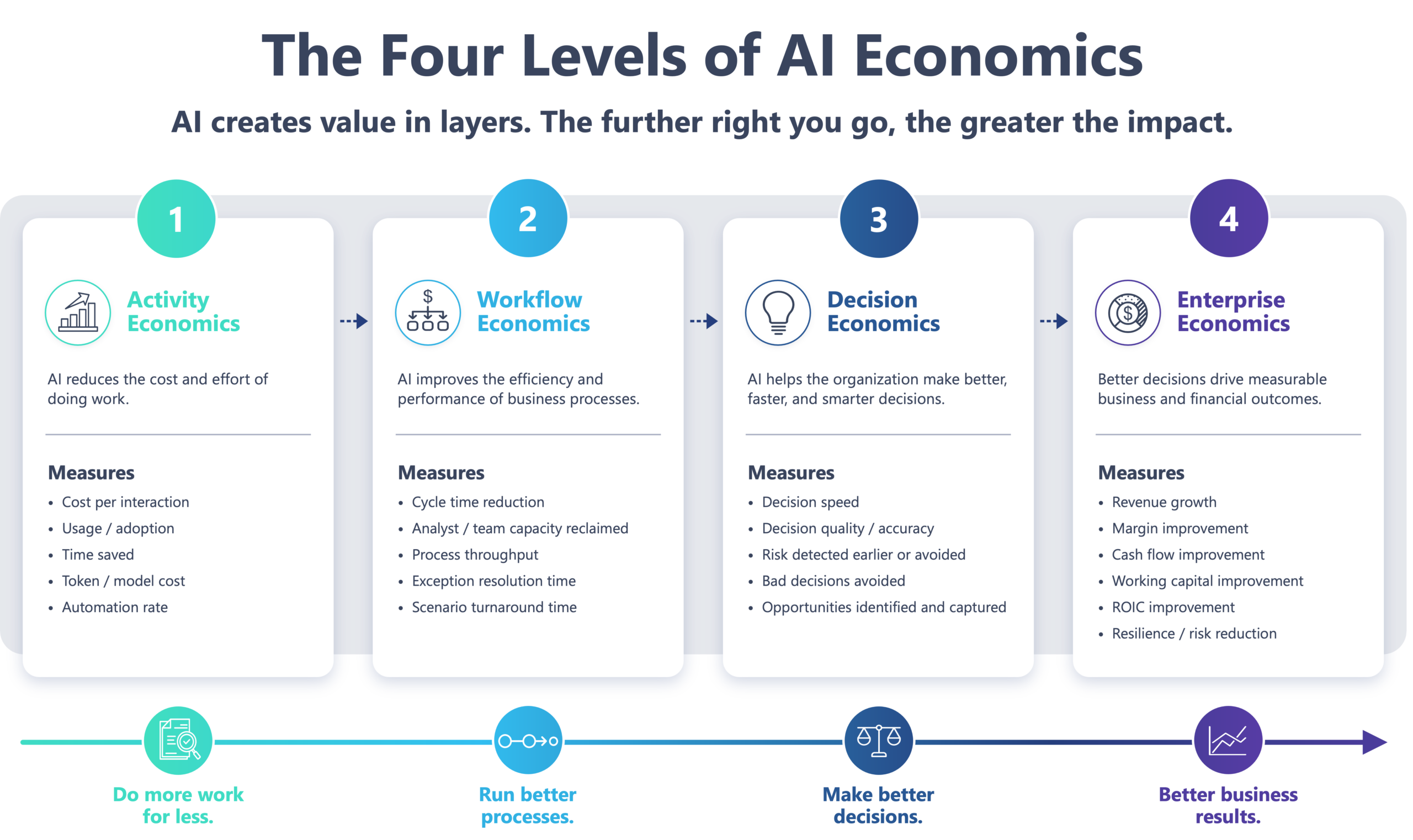
At the first level are activity economics: How much does AI cost? How often is it used? How many hours does it save?
At the second are workflow economics: Did forecasting become faster? Did reconciliation effort fall? Did the close accelerate? Can FP&A evaluate more scenarios without adding people?
These are important and measurable benefits. In Board’s own closed-beta work with enterprise finance teams, for example, one multi-entity intercompany reconciliation workflow fell from approximately a full day of manual effort to about one hour after the workflow was configured and validated.
But the third level is decision economics: Did AI help us identify a risk sooner, evaluate an option we otherwise would have missed, change a forecast while there was still time to act or avoid a poor allocation of resources?
Finally come enterprise economics: Did those improved decisions ultimately affect cash, margin, revenue, working capital, return on invested capital or resilience?
The distinction matters because activity does not automatically compound into enterprise value.
Follow the Value From Intelligence to Outcome
Here is where measuring AI gets harder, and more useful.
An AI system can produce an excellent recommendation and create no economic value at all. If nobody acts on it, the recommendation is simply information. Conversely, a seemingly modest insight can be enormously valuable if it changes a consequential decision at the right moment.
That means CFOs need to establish a line of sight between what the AI knew and what the business ultimately gained.
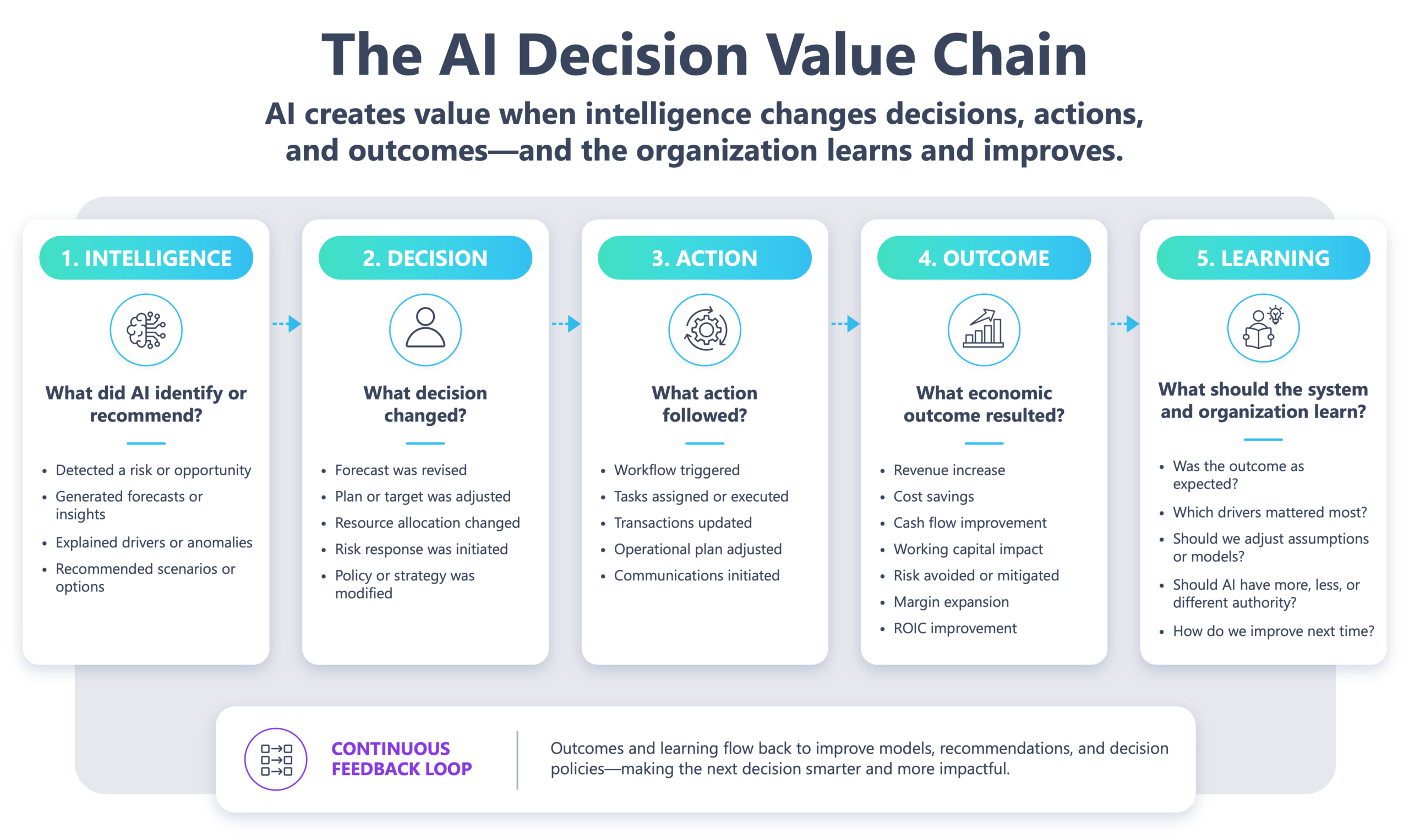
The chain begins with intelligence. Perhaps AI detects an emerging margin problem, challenges a forecast assumption, or identifies a working-capital risk earlier than the existing process would have.
But an insight is not a return.
Value begins to emerge when that intelligence changes a decision. Finance revises the forecast. A business leader changes a spending plan. A collections team reprioritizes accounts. Management chooses a different scenario because the risks and trade-offs became visible sooner.
Even then, a decision only creates value when it leads to action. What actually changed in the business? Was capital reallocated? Was inventory moved? Was spending reduced? Was a supplier commitment altered? Was a risk mitigated while there was still time to respond?
Only then can finance assess the outcome. Did cash improve? Was margin protected? Did forecast error decline? Was a loss avoided? Did the company capture an opportunity it otherwise would have missed?
And then comes the step that becomes especially important in an agentic enterprise: learning.
The organization can compare what AI recommended with what people decided and what actually happened. Which recommendations created value? Which were rejected correctly? Where did human judgment outperform the system? Where did the system see something people missed?
Over time, that evidence can improve more than the AI. It can improve the way the enterprise makes decisions, including how much responsibility it is willing to give intelligent systems.
This fundamentally changes the economics of AI.
Signals change. New scenarios are evaluated. Decisions are made. Outcomes become visible. What happened then informs the next decision. That is consistent with the Continuous Planning model we are building at Board, where signals, scenarios, plans, actions, and outcomes remain connected rather than disappearing into separate systems and planning cycles.
For CFOs, that means ROI itself must evolve.
Instead of asking periodically whether an AI investment produced a return, we should increasingly be able to see which AI-assisted decisions are creating value, which are not, and why.
ROI becomes something the enterprise continuously observes and improves, not simply something finance calculates after implementation.
The Agentic Enterprise Will Require Continuous ROI
That shift will become even more important as AI moves from assisting individual tasks to participating in larger parts of how the enterprise plans and operates.
Gartner’s recent research suggests productivity-focused AI is increasingly becoming table stakes rather than a durable source of competitive advantage. Its analysis found stronger corporate performance associated more closely with intentional AI deployment across growth and decision-making use cases than with AI spending levels alone.
That makes sense. Saving an analyst four hours is valuable. Helping identify a $20 million risk earlier is potentially much more valuable. Helping the organization continuously identify risks, evaluate alternatives, and make better decisions across hundreds of situations is where the economics become transformational.
But we will not understand that value by counting prompts, licenses, or even hours saved.
Finance will need to connect AI interventions to the business decisions they influence and the economic outcomes that follow. That means understanding the context, assumptions, scenarios, actions and results surrounding important AI-assisted decisions, while preserving human accountability for consequential choices.
That is also why governed planning environments become more important as AI moves deeper into enterprise decision-making. Board’s platform strategy is built around connecting AI with planning context, scenarios, workflows, and human accountability rather than treating AI as a standalone productivity layer.
CFOs have an opportunity to establish that discipline now.
We should absolutely measure what AI costs, how widely it is adopted and how much work it performs. Those measures still matter, but they are inputs to the business case, not the destination.
The real economic promise of AI is not that machines will do more work.
It is that the enterprise will make better decisions because of them.
And the CFO’s next AI scorecard should be designed to prove it.